
Etching
- TOP
- Etching
What is Photo-Etching Process?
Photo-etching is a technology that uses chemicals to corrode metal and chemically cut it.
It is also known as chemical milling (machining) in other countries, and it is possible to process sheet metal into various shapes by using chemical reactions.
The "photo" in "photo etching" refers to the precision photographic technology called photolithography, and we are good at processing complex shapes.
The special processing of chemical reactions and photolithography makes it possible to process "small, thin, and complex" products that are difficult to process with ordinary methods.
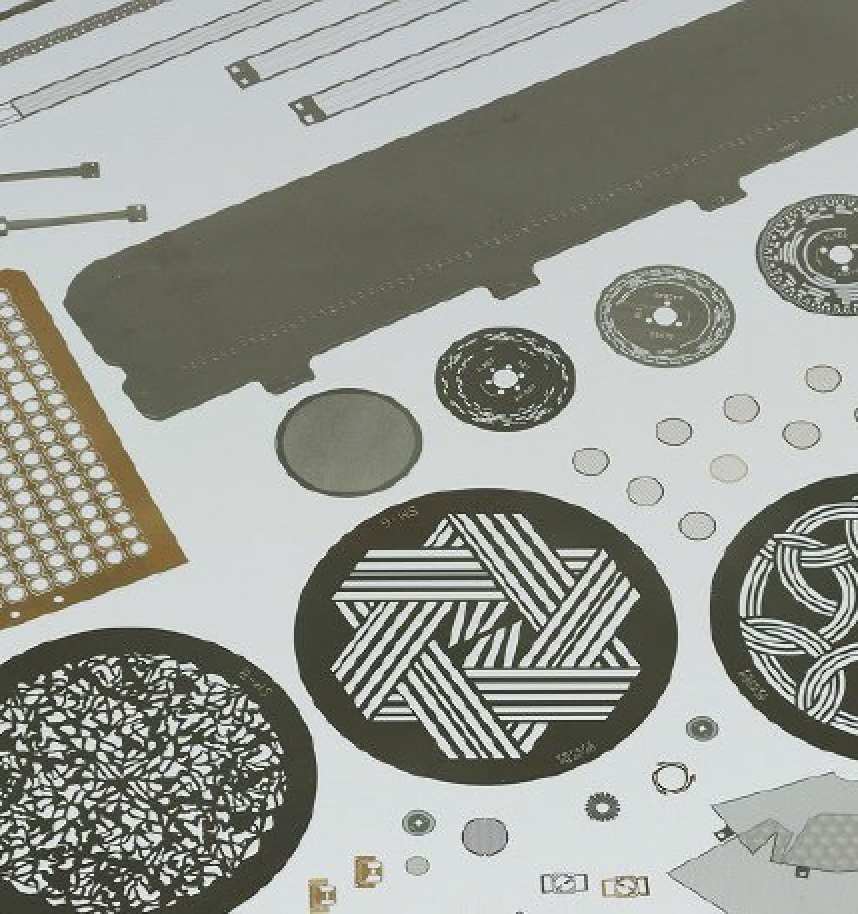
Technical features of Photo-etching
Small, thin, and complex processing is possible.
No burring, warping, or distortion of the product.
No material alteration and no deformation due to heat or stress.
Half-etching can be used to create grooves or protrusions at any depth within the plate thickness, and the plate thickness can be adjusted.
No need for expensive molds and jigs, initial cost can be reduced significantly.
Accuracy and processing limits
Bridge



Etching is processed by facing multiple pieces of product. The joint between the sheet and the product is called a "bridge". In the standard specification, the bridge is designed to be attached. Negotiable if bridge is not required
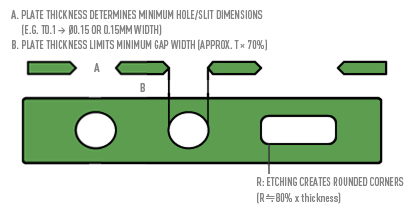
Cross-sectional shape

The cross section of an etching process is not a straight line. It will look like a bowl, and the shape differs between single-sided etching and double-sided etching. (See figure).
Processing possible size
Since the etching process does not apply stress to the metal, burrs, distortions, chips, etc. do not occur, unlike machining, pressing, etc.
Compare with Laser and Press
| Laser | Etching | Press | |
|---|---|---|---|
| Prototype cost | Processing cost | Etching master + processing cost | Die + processing cost |
| Unit price | High | Middle (lower than laser) | Lowest |
| Standard delivery time | about 1 week | within 3-4 weeks | 6 weeks to 6 months |
| Tolerance (thickness ratio) | ±5%程度 | ±15%~(板厚による) | ±10%程度~ |
| Stress | Thermal stress on cutting surface | None | Press stress on cutting surface |
| Burr | Minute burr | None | Burr on cutting surface |
| Material hardness | No limit | No limit |
Extremely soft, hard or brittle materials are not our strong point. |
|
Design change Degree of freedom |
High degree of freedom Design can be changed at low cost |
High degree of freedom Design can be changed at low cost |
Design change of die High cost |
| Production Capacity | Low | Middle | High |
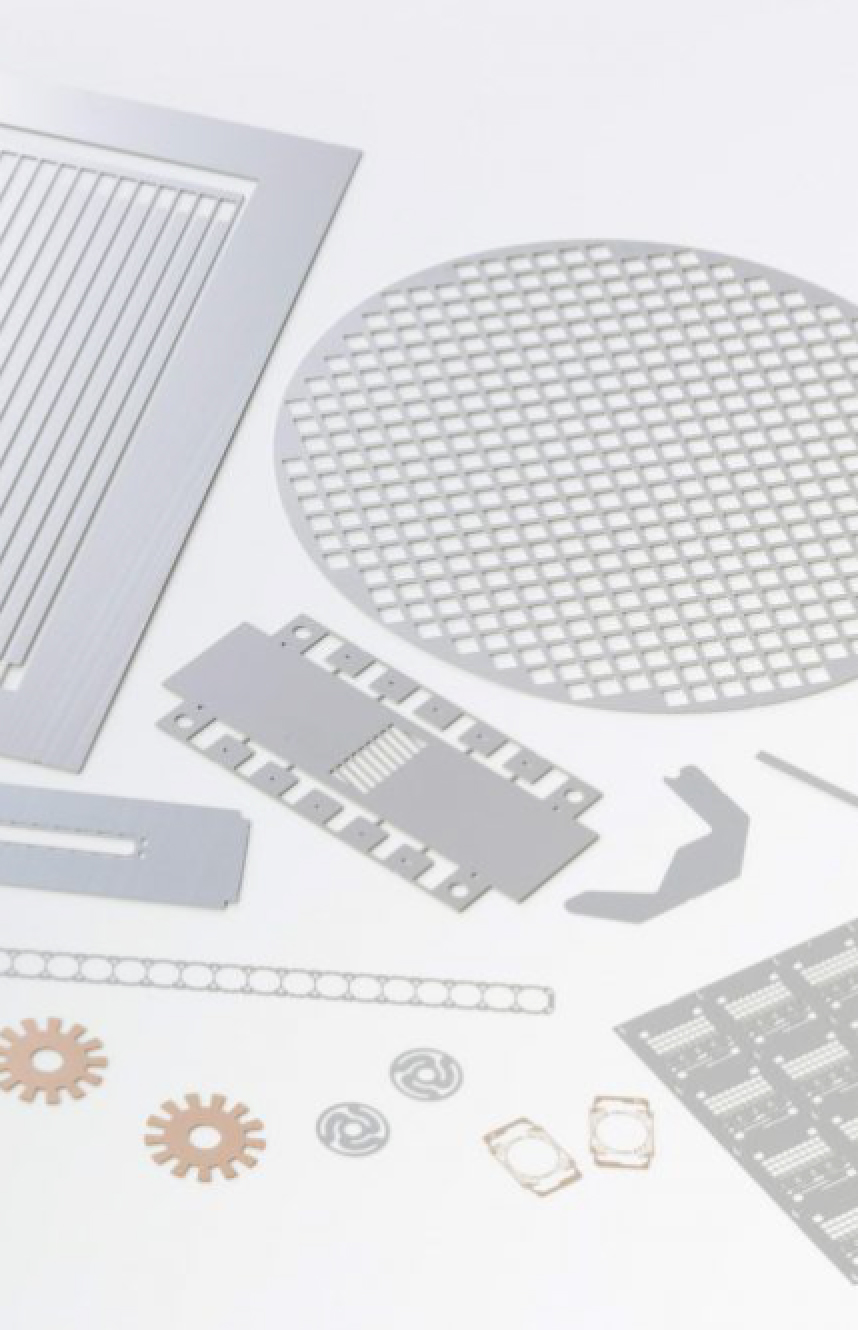
Materials that can be processed
- General metal materials
-
Stainless steel (SUS), copper (Cu), iron (Fe)
Nickel (Ni), aluminum (Al), other
- Special metal materials
- Etching availability can be easily determined. Please feel free to contact us with any requests you may have. Our most common material is SUS. Please feel free to consult us about other metals.